From "How did you go?" to "How are you growing?"
Introducing Approaches to Learning at Redlands, and the conversation we hope it starts at home.
Most conversations about school begin with a result. How did you go in the test? What did you get for the assignment? It is a natural place to start and results matter. But when the number becomes the only question we ask, a child learns very quickly that it is the only thing we value.
Caring about more than that is not new for Redlands. What has been harder, for us and for every school, is making the capabilities that sit underneath good learning something families can recognise, talk about and help to grow. Approaches to Learning gives us a shared language for that growth.
Earlier this year, working alongside researchers from the University of Technology Sydney, we sat down with students, parents and teachers to better understand the everyday experience of learning at Redlands. We wanted to hear, in their own words, what learning felt like, what they valued most, and where they believed we could do even better.
What emerged was both encouraging and challenging. Students told us that they were sometimes moved on before an idea had really landed, because the syllabus had to be covered, and that while they wanted to be stretched, they wanted the kind of help that made them more independent rather than help that did the thinking for them. Across those conversations, one message kept returning. Academic success is important, but a mark is not the measure of a person. As one parent put it, Redlands is also about growing each student as a person.
The question then became how to make those aspirations visible in everyday learning. Values matter, but they only shape a child’s experience when they become something teachers can notice, coach and develop over time. Approaches to Learning gives us that shared language. It names four capabilities, drawn directly from our School values, that support successful learning. None of them is a fixed trait a child is simply born with or without. Every one of them can be developed, and that belief sits at the heart of everything that follows.
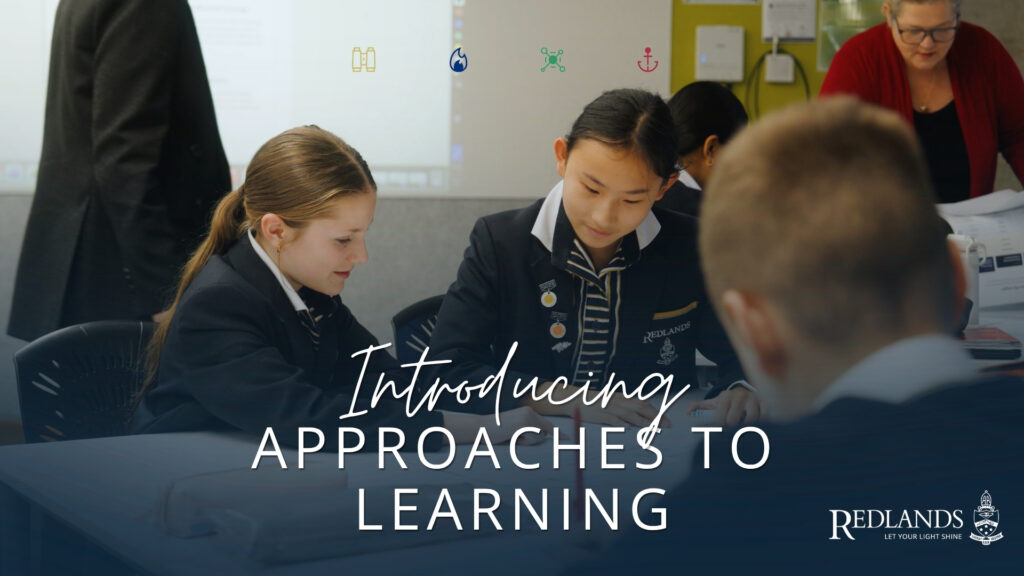
- Curiosity, the binoculars, is about choosing to look further: noticing what you do not yet understand and wanting to explore it.
- Intellectual Courage, the flame, is about keeping going: choosing challenge, persisting when learning becomes difficult, and growing from setbacks, mistakes and feedback.
- Connection, the constellation, is about finding your place: working with others in ways that help everyone learn and succeed.
- Responsibility, the anchor, is about staying grounded: managing yourself as a learner and taking ownership of your choices, effort and growth.
Our aim is simple: to help every young person become more aware of themselves as a learner, so they leave Redlands not only with strong results, but with the habits that will help them continue learning throughout their lives. For the first time, students, teachers and families will all be using the same language to describe how learning grows.
What is new is not the values themselves, but a shared language for how they show up in learning, and a clearer picture of how each capability develops as a child moves through the School. What curiosity looks like in Year 3 is not what it looks like in Year 11, and it should not be. The capability stays the same; what grows is the sophistication a young person brings to it. Because it is part of learning from Kindergarten to Year 12, it can be deliberately taught, coached and strengthened at every stage.
You may be wondering what happens to the things you are used to seeing on a report: diligence, engagement and behaviour. They have not disappeared. They have grown up. Rather than reporting those qualities as separate measures, we now describe them through the capabilities that sit underneath successful learning. Responsibility, for example, is what diligence becomes over time: managing yourself as a learner, reflecting on your progress, acting on feedback and taking ownership of what happens next.
Across the School, students receive feedback on all four capabilities each semester. In the Junior School, teachers observe each child’s growth. As students mature, they begin reflecting on their own learning alongside those observations. Together, those perspectives create something more valuable than a single rating: a shared language for conversations between students, teachers and families about strengths, next steps and growth over time.
We want this to make a real difference to how your child learns, not just add four new words to a report. Earlier this term, every academic teacher in our Secondary School came together to explore how these capabilities could be deliberately built through everyday classroom practice. We began with curiosity because, of the four capabilities, it is perhaps the one most readily praised and least often taught: everyone hopes for a curious child, yet few lessons are deliberately built to grow curiosity. That gap is why it needed our attention first.
The research here is encouraging, and it is worth reflecting upon, because it changes how all of us might respond when a child seems to switch off. Curiosity is not a fixed trait that a student either has or lacks; it is a state that responds to the conditions around it. Susan Engel’s classroom research found that curiosity tends to fade the longer children are at school, and when Jennifer Jirout studied ordinary lessons, the moments that sparked it were surprisingly rare. That is a finding about classrooms, not about children, which is why our first response has been to change what teachers do, rather than wait for the right sort of student to arrive. Curiosity also rests on knowledge. As George Loewenstein’s information-gap theory explains, curiosity arises from the space between what we know and what we want to know, so a child needs enough grounding to notice the gap in the first place. This is why strong teaching and curiosity pull in the same direction rather than competing. Taken together, this is why no child is simply “not a curious one”, or “not a maths person”. The conditions are ours to design, at school and, in a smaller way, at home. When your child is stuck on something hard, the most useful thing you can do is often not to hand over the answer, but to stay in the not-knowing alongside them a little longer, and to look further together before reaching for certainty.
All of this points to one change above the rest: how we talk with a child about their learning. Not only how did you go, but how are you growing. A young person who can look clearly at themselves as a learner and keep going when the work is hard is learning something that will outlast any single result. They are becoming someone who can meet new challenges long after they have forgotten this year’s assessment task.
None of this replaces the report, the results, or the ATAR your child is working towards. It sits alongside them and asks a longer question: not how your child is doing this term, but who they are becoming as a learner.
Our short film for families brings these ideas to life. We hope you’ll watch it with your child and let it begin a conversation we’ll continue together at school.
Mrs Liz Green
Redlands Director of Learning and Growth