Sean
Bayles (RL 11)
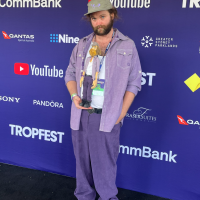
Looking back on your time at Redlands, were there particular subjects, teachers or experiences that helped shape your creative interests or career direction?
Truth be told, I wasn’t the most engaged student at Redlands. I wasn’t disruptive, but it took until later in my education to develop discipline and focus. Over time, I found my way to enjoying learning and engaging more seriously with study.
That said, I gained a lot from the music and art department, and I feel I was given the tools to engage deeply when I was ready. Looking back, there are things I learned in Year 8 or 9 in Mr Byrne’s art class that I still return to in my creative process. The two ideas that stayed with me were “taking your idea and putting it on steroids” and recognising that truly original ideas are rare, so it’s important to understand how others have approached similar concepts or materials.
Mr Harpley was also very influential, and I’m grateful to have had him as a teacher from Year 6 through to HSC Art in Year 12. He helped shape my ability to think critically about art and engage with more challenging conceptual work. While supportive, he was also quite no-nonsense, which I really respected.
What was the transition like for you after finishing school? How did you navigate those early decisions about study, work or pursuing film?
I moved to Vermont to study at UVM after finishing at Redlands with an open mind about the future. I began a liberal arts degree with no declared major, and early encouragement from art instructors pushed me to work harder and think bigger creatively.
I eventually settled into a visual arts major with philosophy and music minors (missing an art history minor by one class). I later found my way into the clay studio, where I became fully engaged artistically. I spent countless hours at the pottery wheel and firing kilns, and eventually worked as a lab tech after graduating. Hoyt Barringer had a significant impact on how I think about form and function.
It wasn’t until years later, during COVID, that I began experimenting with animation. With a strong sculptural background, it was largely a matter of transferring mediums. I was drawn to it as an art form that didn’t require much space or specialised equipment. I developed photography skills over time, initially using my phone to capture animations.
I started by making clips for music I was creating, then moved into music videos for other artists. I had considered making a short film for a while but never got past the planning stages—something I later learned is quite common. The deadline for the Tropfest submission finally pushed me to complete something and put it out there.
Winning the Tropfest 2026 Tropicana Award is an incredible achievement — what does this moment represent for you in your career journey so far?
Winning the Tropicana Award feels great and a little surreal. I’ve been working on stop-motion animation for the past five years, developing my craft, honing my skills and finding my voice. I typically work on music videos for other artists and am often guided by the content or vibe of the track.
The End was the first time I was fully responsible for all aspects of the creative output, which was a valuable learning experience. The tight time constraints were also helpful, pushing me toward something simple but effective. Many stylistic choices were made to minimise production time while still delivering a few minutes of animation.
Overall, the project felt like a culmination of my previous work, distilled into a tight, refined piece. I’ve always had confidence in my work and been proud of the output, but this is the first time it’s been recognised in this way, which is incredibly validating and encouraging. I’m hoping it marks the start of an upward trajectory, allowing me to expand budgets and timelines for more ambitious work.
What does your work look like currently, and what projects or ideas are you most excited about right now?
At the moment, I’m looking to build on this success by securing larger-scale projects where I can expand creatively. I’ve generally worked within tight timelines and budgets, which has helped develop my skills as an animator. Creative problem-solving under pressure often leads to strong artistic outcomes. Having developed my skill set, I now feel ready to take on larger productions and achieve more satisfying results. I have several short film ideas and am exploring ways to secure funding for them.
The project I’m most excited about is a film centred on conspiratorial thinking and cult behaviour. I’ve been developing this idea for some time, and it feels increasingly relevant. Positive feedback on The End has been strong motivation to finally bring it to life.
I’d also love to return to recording music and creating my own music videos. I really enjoyed my earlier work—it was quite zany and character-driven—and I’d be interested in revisiting that style with a higher level of craft.
What’s something you love doing just for yourself — no deadlines, no projects, just pure fun?
I enjoy running and cooking in my spare time. Running is a fairly new hobby, and I’m still surprised I’ve gotten into it. I now enjoy longer distances and improving my speed—it’s a great way to clear my head, and I feel better when I’m running a couple of times a week. I’m hoping to crack a four-hour marathon, maybe Sydney 2027 if I can get in.
I also enjoy tackling a complicated cook. I love food, and it’s even more satisfying after a few hours in the kitchen. I particularly enjoy baking and now eat almost exclusively homemade sourdough, and I’m exploring Indian cuisine for more savoury cooking. The two hobbies pair well together, which is a bonus.